Blog
»
{{catList[366].label}}
» Monastery of Los Jeronimos
Monastery of Los Jeronimos

The Monastery of Los Jeronimos is located in the Murcian district of La Ñora.
This Murcian work dates back to the 18th century. The design is credited to the architect Fray Antonio de San Jose due to its similarity to his other works. The monastery is also known by the pseudonym "El Escorial Murciano".
The Monastery of Los Jeronimos currently belongs to the Catholic University of San Antonio. It is a magical place that captivates travellers. Palm and fruit trees give it a summer touch.
In the 1980s, the monastery was declared a National Historic-Artistic Monument given the large number of works of art it contains, such as the organ and an Immaculate Conception attributed to Salzillo, as well as two praying angels that went to the chapel of Our Lady Saint Mary of Arrixaca in San Andres but which are now in place. There are also images of Saint Roch, the Christ of the Souls, two angels kneeling before a crucifix and Saint Antony.
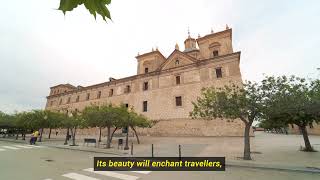

 Its original name was Monastery of San Pedro de Ñora, and it was built between 1574 and 1578 by Alonso Vozmediano de Arróniz.
This Murcian work presents a Baroque style, as it has a brick surface, a very high arched door and two slender towers that point to the sky, with pointed domes, along with a blue stained glass window characteristic of this style.
Inside the monastery, the same Baroque style prevails; stucco predominates in the decoration of the capitals, as well as in the cloister and on the cornice.
Without a doubt, it is an ideal place for travellers who love history and architecture.
This Murcian work dates back to the 18th century. The design is credited to the architect Fray Antonio de San Jose due to its similarity to his other works. The monastery is also known by the pseudonym "El Escorial Murciano".
The magic of the Monastery of Los Jeronimos
This architectural work has a church with a polygonal cupola supported by large columns. Inside, it contains a wide variety of decorative relief figures of parents who have passed through the church and a window with figures of children.The Monastery of Los Jeronimos currently belongs to the Catholic University of San Antonio. It is a magical place that captivates travellers. Palm and fruit trees give it a summer touch.
In the 1980s, the monastery was declared a National Historic-Artistic Monument given the large number of works of art it contains, such as the organ and an Immaculate Conception attributed to Salzillo, as well as two praying angels that went to the chapel of Our Lady Saint Mary of Arrixaca in San Andres but which are now in place. There are also images of Saint Roch, the Christ of the Souls, two angels kneeling before a crucifix and Saint Antony.
History of the place
Almost three centuries have passed since the monastery was built on the current site, where the headquarters of the Catholic University of San Antonio has been maintained since 1996.
This convent is the largest credited to the Hieronymite order in Murcia and enjoys a privileged location in a high area that provides great security.
This convent is the largest credited to the Hieronymite order in Murcia and enjoys a privileged location in a high area that provides great security.
Architecture of sublime simplicity
The Monastery of Los Jeronimos dazzles architecture lovers. Its noble brick and mud façade makes its sublime simplicity a work of art that contrasts with the general plans of the entire building.This Murcian work presents a Baroque style, as it has a brick surface, a very high arched door and two slender towers that point to the sky, with pointed domes, along with a blue stained glass window characteristic of this style.
Inside the monastery, the same Baroque style prevails; stucco predominates in the decoration of the capitals, as well as in the cloister and on the cornice.
Without a doubt, it is an ideal place for travellers who love history and architecture.
Activities in the region of Murcia


Share Article
More Articles


